

Technology
Apple came late to the foldable — so what did it do differently from Samsung?
The iPhone Duo isn't lighter or thinner. Apple's difference is treating the inner and outer screens as two scales of the same interface rather than two separate spaces.
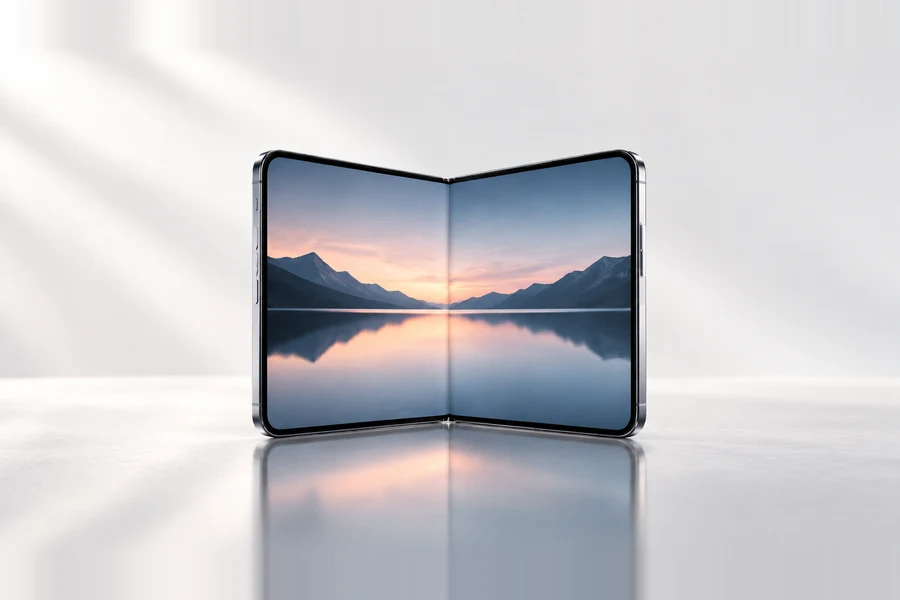
At its September 9 event, Apple introduced its first foldable phone: the iPhone Duo. Samsung is on its eighth generation in the category; Apple is on its first. What I was curious about wasn't the feature list. Someone arriving seven years late, on a product they made everyone wait this long for: what do they do differently?
Looking at the spec sheet, the first impression is surprising: Apple is behind on most of the measurable headings.
Samsung leads on the numbers
The Galaxy Z Fold 8 weighs 201 grams. The iPhone Duo weighs 254. Those 53 grams are a difference you feel in a pocket and in the hand. Thickness tells a similar story: the Duo is 11.3 mm folded, the Fold 8 is 9.7. Even open, Samsung is thinner, 4.5 mm against 5.2.
Apple has its wins too: a Grade 5 titanium frame (Samsung uses aluminium) and IP68 protection against IP48. It's worth being precise about where that gap is. The second digit of the IP code is water resistance, and both are 8. The difference is in the first digit, dust and solid-particle protection: 6 versus 4. Apple is clearly ahead on dust.
The camera, contrary to what I expected, isn't an axis of separation. The Duo has two rear cameras, a 48 MP main and a 48 MP ultra-wide, with no dedicated telephoto. The Fold 8 is the same story: 50 MP wide and 50 MP ultra-wide, no telephoto. Samsung's 3x optical telephoto lives in a separate model, the Fold 8 Ultra. Both phones zoom by cropping the main sensor.
So the "Apple came late but did everything better" story doesn't hold up. On weight and thickness, Apple is clearly behind.
What Apple did differently: treating two screens as two scales of one interface
One detail in Apple's own announcement explains the whole design choice: the two screens share the same aspect ratio. The 5.4-inch outer screen and the 7.6-inch inner screen have identical proportions. Apple emphasizes that this lets content scale proportionally and keeps visual continuity when you open the phone.
On Samsung, the two screens have different ratios: the outer one is tall and narrow, the inner one close to square. When you open the phone, content doesn't just get bigger; it moves to a different shape.
Let's not overstate it. Apple's developer documentation also describes apps re-laying out on the inner screen, interface hierarchies expanding, and controls relocating. So "when you open it, the same page just gets bigger" would be wrong. The goal is more continuity in the transition; matching the ratio is the hardware side of that.
Apple's CEO, Ternus, said at the launch that rivals "feel like two phones crudely glued together." Marketing, of course, but the engineering decision behind it is real: to hit the same ratio, the body dimensions, hinge, and screen sizes were set accordingly. How much that geometry has to do with the weight and thickness disadvantage is something we can't know from the outside; there are dozens of variables, from battery and hinge to casing and display layers.
Three small decisions, one logic
The same approach shows up in three other places.
The inner-screen camera is hidden when not in use. According to Apple's developer documentation, the front camera normally stays hidden; when it's active, the system reserves space for it. The Fold 8 uses a visible 10 MP camera on the inner screen.
The fingerprint reader is back. There's no Face ID on the Duo; Touch ID is built into the power button. Apple says it chose this because it gives consistent authentication whether the phone is open or closed. There's no official explanation of why Face ID was dropped.
A nano-texture inner display. The matte coating Apple has used on some displays before is here too. Apple says that beyond reducing reflections, it also makes the crease less visible. Since the crease is most noticeable when light hits the screen from the side, that sounds plausible; how well it works in real use we'll see once the device ships.
All three are parts of the same sentence: make you forget the phone is foldable while it's open.
Is that enough?
I don't know, and at this point there's no way to know. Everything I have is Apple's own narrative and the spec table; the device isn't in anyone's pocket yet.
Two things keep me skeptical.
First, 254 grams is a real weight. The extra 53 grams you carry in your pocket all day will be noticed more often than a "smoother screen transition." Apple's bet is that this trade-off pays off on the user's side.
Second, the real problem with foldables was never the screen ratio. It was durability, price, and "what am I actually doing with the big screen." Apple doesn't answer the first two: in Turkey, the 256 GB model starts at ₺229,999, and how the hinge holds up over the long run is something we'll only know in a few years.
Why this is interesting
By TrendForce's estimate, the foldable market will reach about 20.2 million units in 2026, which is 0.5% annual growth. In other words, the category is effectively standing still.
That's why Apple's entry will test not so much whether the market grows, but whether the problem Samsung has prioritized for years is the problem users actually care about. Samsung has long been working on portability, weight, and form factor. Apple didn't join that race; it came in from somewhere else, apparently putting the continuity between open and closed use at the center of the design.
The next year will show which of these two approaches lines up with what people really care about.
The iPhone Duo opens for pre-order in Turkey on October 16 and goes on sale on October 23.