
GLONASS disappeared from the Apple Watch Ultra 4. So why is it still on the Series 12?
Apple removed Russia's GLONASS satellite system from the new Ultra. The obvious explanation is political — but the Series 12, launched the same day, still supports it. That single detail changes the story.
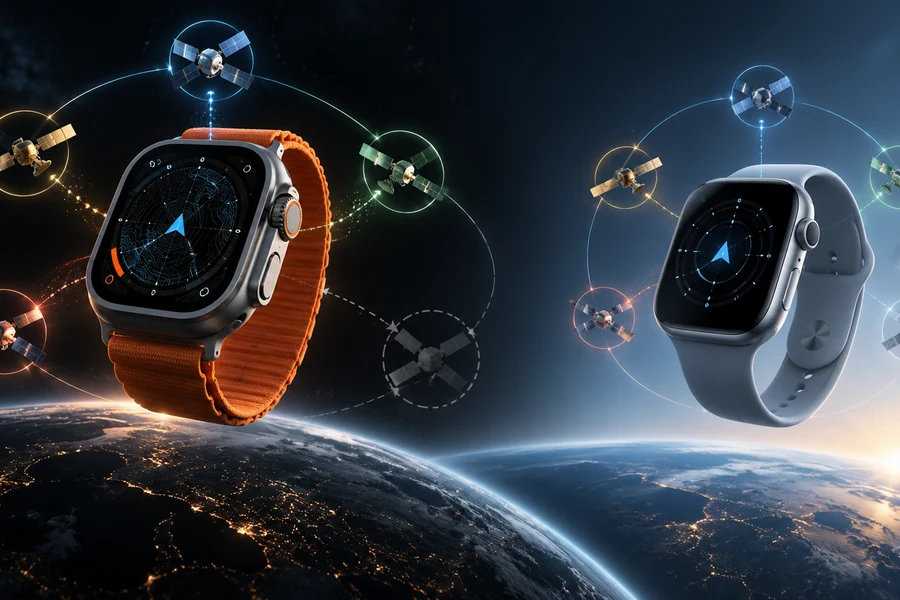
There is a small change on the Apple Watch Ultra 4's technical specifications page. The satellite systems listed are GPS, Galileo, QZSS, and BeiDou. On the previous generation, the Ultra 3, there was one more: GLONASS.
GLONASS is Russia's satellite navigation system. In 2026, when an American company removes Russian infrastructure from one of its products, one explanation immediately comes to mind.
But there is a detail that makes that explanation much harder to sustain.
GLONASS is still on the Series 12
Apple introduced the Apple Watch Series 12 on the same day as the Ultra 4. Its specifications list the following satellite systems: GPS, GLONASS, Galileo, QZSS, and BeiDou.
So Apple has not removed GLONASS from the Apple Watch lineup. It has removed it only from the Ultra 4.
If the decision were directly political or sanctions-related, the fact that GLONASS remains on the Series 12 launched the same day would make that explanation harder to square.
That single detail significantly weakens the first explanation that comes to mind. So what is left?
First attempt at an explanation: dual-frequency positioning
The clearest technical difference between the Ultra 4 and Series 12 is in positioning: the Ultra 4 uses a dual-frequency receiver (L1 and L5), while the Series 12 uses a single-frequency receiver (L1).
Dual-frequency positioning compares signals received on two different bands, helping estimate and correct delays introduced by the atmosphere. It can reduce positioning errors between tall buildings in cities or under tree cover in the mountains.
There is also a wrinkle on the GLONASS side: consumer devices generally receive only its L1 signal. Its traditional civilian signal also uses a different architecture from the others, which can require additional correction work in the receiver.
That suggests a possible explanation: in a high-precision dual-frequency receiver, accounting for a system that contributes only a single frequency could add complexity rather than improve accuracy. On the single-frequency Series 12, that issue would not exist — it is already receiving L1 from every system, so GLONASS would simply be one more source.
It sounds plausible. But it does not hold up.
The third data point breaks that explanation too
Look at the Ultra 3's specifications. Apple's own page says it used precision dual-frequency L1 and L5 GPS — and GLONASS was among the supported systems.
In other words, the Ultra 3 was both dual-frequency and GLONASS-compatible.
That alone invalidates the explanation above. If dual-frequency positioning and GLONASS were fundamentally incompatible, they could not have coexisted on the Ultra 3 either.
There is another wrinkle: GLONASS signal architecture is not as uniform as it is often described. The system has added CDMA-based civilian signals as part of its modernization. So saying "GLONASS uses a different architecture, therefore it is incompatible" is too simplistic.
What is left?
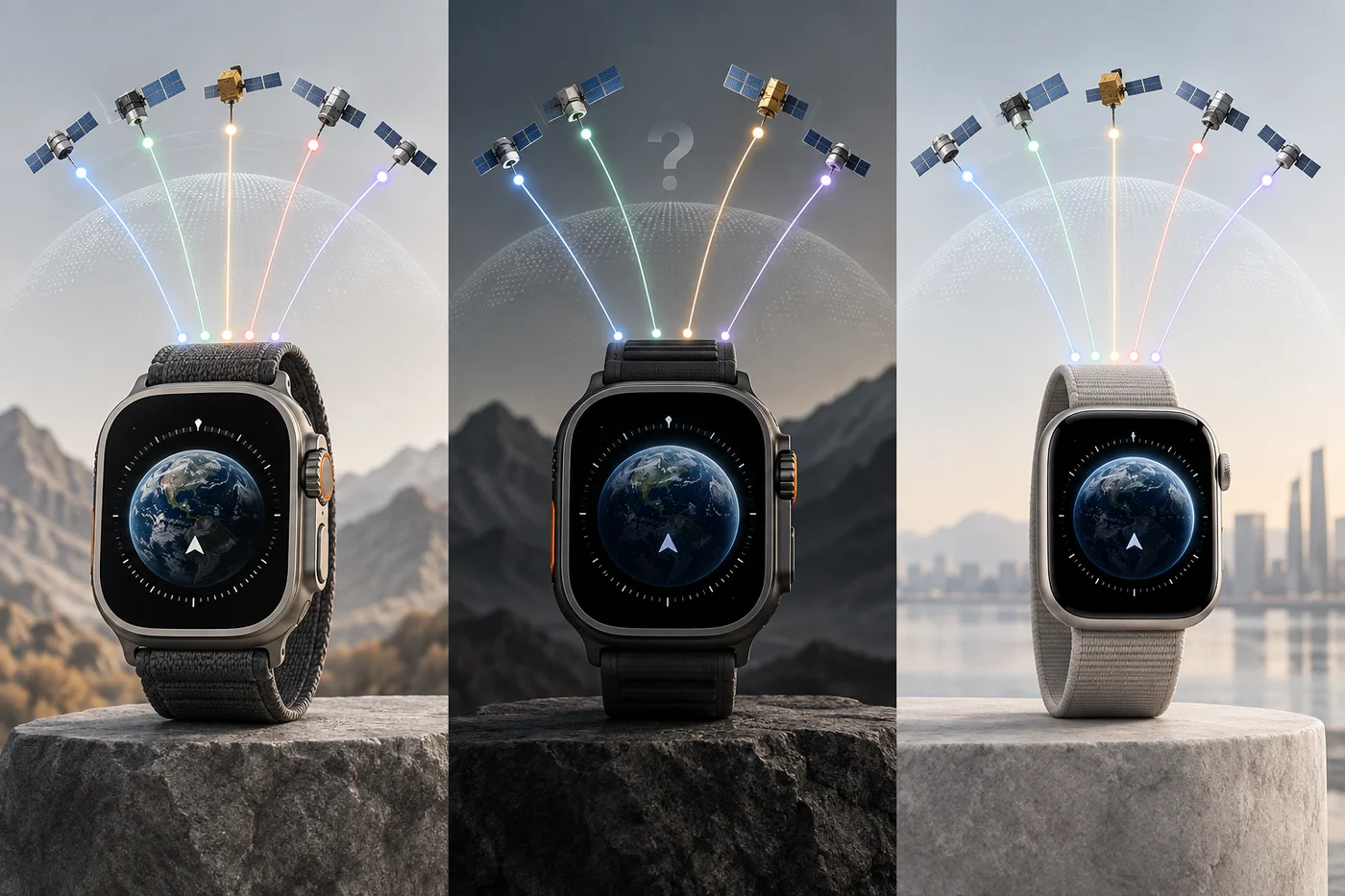
We have three data points, and together they tell us this:
| Model | Frequency | GLONASS |
|---|---|---|
| Ultra 3 | Dual (L1+L5) | Yes |
| Ultra 4 | Dual (L1+L5) | No |
| Series 12 | Single (L1) | Yes |
The Series 12 weakens the political explanation. The Ultra 3 weakens the technical explanation. What remains is a list of possibilities — and they are all speculation:
- A change in the new chipset or antenna design
- A revision to the GNSS algorithm
- A certification or validation decision
- Power-consumption or processing-load optimization
- A documentation-only change — meaning the hardware may still be capable of receiving it
We cannot confirm any of them. Apple has not explained the reason.
Did accuracy get worse?
Apple's own claim points in the opposite direction. It describes the Ultra 4 as having "the most accurate on-device GPS in a sports watch" and bases that claim on its own comparative testing against other dual-frequency sports watches.
If removing one satellite system had noticeably hurt positioning accuracy, making that claim would be an odd choice.
There is a counterintuitive point here: with satellite positioning, "the more systems, the better" is not automatically true. What matters is which signals the receiver can use, how well it can use them, and what the software does with the data. Adding a weak or poorly integrated source can muddy the solution instead of improving it.
Nobody has measured the real-world effect yet
It is also worth saying this clearly: you cannot tell what this means in actual use from a specifications page.
Only independent testing can answer that — ideally an Ultra 3 and Ultra 4 compared on the same route, under the same conditions. Until that kind of test exists, nobody can say with confidence that accuracy has improved or declined.
Why I am telling this story
This is a tiny line in a specification sheet, and normally almost nobody would notice it. The reason it attracts attention is that GLONASS is Russian.
That is what I find interesting: a technical decision can quickly acquire a broader narrative around it, even when that narrative may have little to do with the decision itself. And what challenges that narrative is not some major announcement, but a single word on the specification page of a cheaper watch launched the same day.
But the story does not end there. The technical explanation I built to replace the political one was undermined in exactly the same way by another specification page — the Ultra 3's.
That, I think, is the real lesson. The second data point breaks the first story; the third can break the story you built in its place. Sometimes, "we don't know why" is the most accurate conclusion available.
TagsApple