
AI Can Control Fusion Plasma in Milliseconds — But It Can't Override the Safety Limits
Princeton's PACMAN framework can predict and prevent plasma instabilities in a tokamak roughly 200 milliseconds before they develop. The more important story isn't its speed: AI can be given real control over a machine without being allowed to change its physical safety limits.
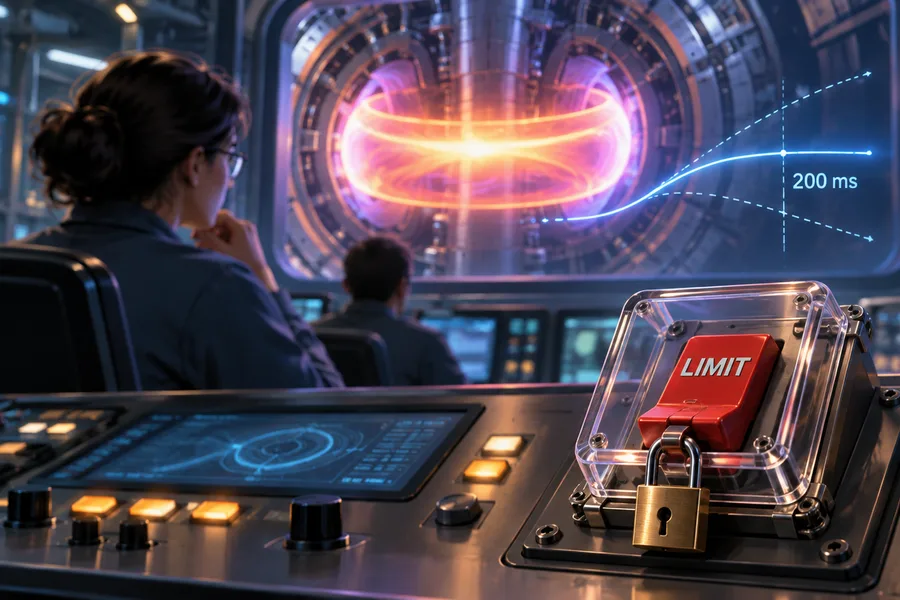
Researchers at the Princeton Plasma Physics Laboratory (PPPL) and Princeton University have developed PACMAN, a control framework detailed in a study published in Nuclear Fusion in July. PPPL announced the results on September 2. The system was tested in five experiments on the DIII-D tokamak in San Diego.
The obvious headline is that AI can control fusion plasma faster than a human can react. That's true, but speed isn't the most interesting part of this story. What makes PACMAN instructive is how much authority AI receives — and where that authority ends.
First, the problem: why humans can't react fast enough
Plasma inside a tokamak can reach temperatures higher than the Sun's core, and it is prone to instabilities. The trouble is that those instabilities can develop in milliseconds.
Human operators react on the scale of seconds. Detailed conventional plasma simulations, meanwhile, can take days or even months. That leaves researchers with a difficult choice: a decision-maker that cannot react quickly enough, or a calculation that cannot finish quickly enough.
As PACMAN team member Hiro Farre Kaga explains, plasma control needs models capable of making decisions on a millisecond timescale.
How PACMAN works
The framework operates through a four-stage loop:
- Collect measurements: Receive live data from the tokamak, including temperature, density and magnetic signals.
- Validate and package: Check the readings and combine them into a structured data package.
- Predict: AI models forecast where the plasma is heading.
- Calculate commands and enforce limits: Controllers calculate actuator commands, resolve conflicts, enforce safety limits and send the resulting outputs to the tokamak.
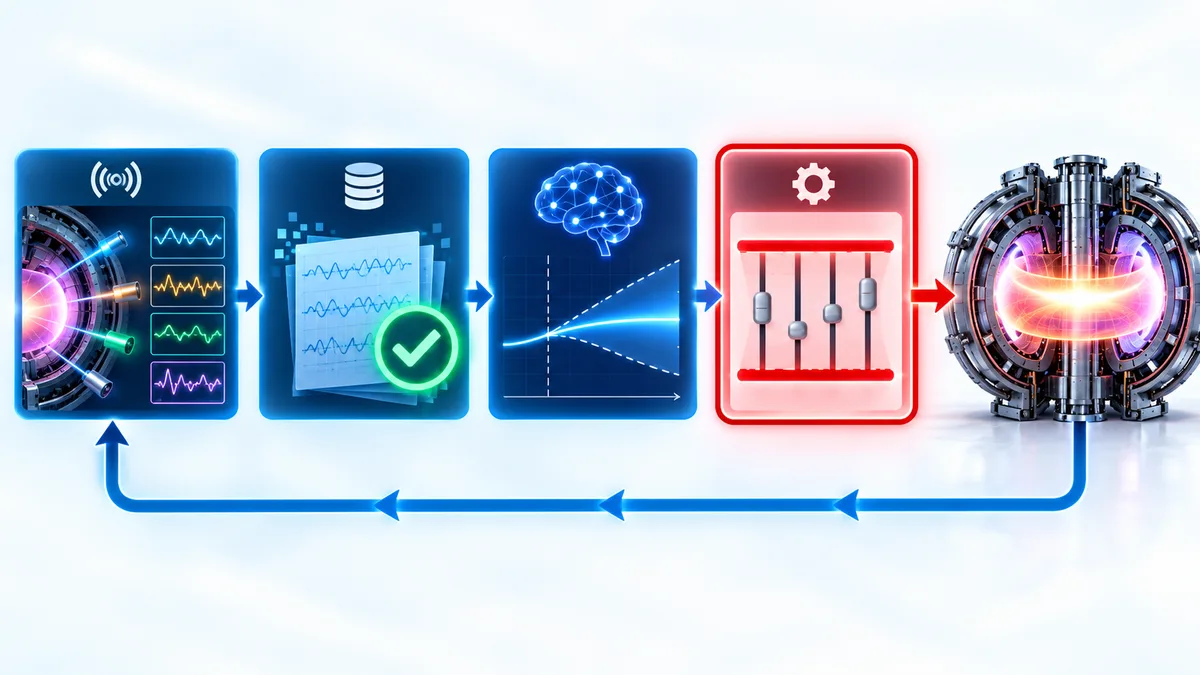
According to team member Andy Rothstein, the PACMAN framework typically operates in roughly 20 milliseconds, repeating the process continuously.
That doesn't mean every model runs on a fixed 20-millisecond cycle. Timing varies by application. For example, the reinforcement-learning controller requires a 50-millisecond PACMAN cycle, while individual models can complete their inference in just a few milliseconds or less.
What the experiments achieved
The DIII-D experiments demonstrated several capabilities:
- Predicting and preventing a tearing-mode instability roughly 200 milliseconds in advance. Conventional controllers detect this type of instability after it has begun. PACMAN can intervene before it develops.
- Predicting sudden energy bursts at the edge of the plasma.
- Coordinating and optimizing six gyrotrons, which are used to heat the plasma.
- Automatically managing heating systems.
The distinction is between detection and prevention. Instead of saying, "A problem has started," the system can effectively say, "At this rate, a problem will develop in about 200 milliseconds."
The key design decision: AI can control the machine, but it can't override the safety limits
This is the point that matters most — and it challenges a common assumption about AI in safety-critical systems.
PACMAN doesn't restrict AI to making predictions. In the reinforcement-learning experiment described in the paper, machine-learning outputs fully determine the actuator commands. The researchers call this "full ML control."
Those decisions, however, must pass through hard-coded machine safety limits before reaching the hardware. Regardless of what a model recommends or a controller calculates, the output layer enforces minimum and maximum actuator values.
The paper gives concrete examples: gas-valve voltages; limits on neutral beam injection (NBI) power and its rate of change; electron cyclotron heating (ECH) power; the physical movement limits of ECH mirror angles; and currents in 3D coils.
There is another revealing rule. If two controllers issue conflicting commands for the same actuator, the system does not send an actuation command and instead alerts the operators.
In other words, its default response to a conflict isn't "pick one." It's "apply neither."
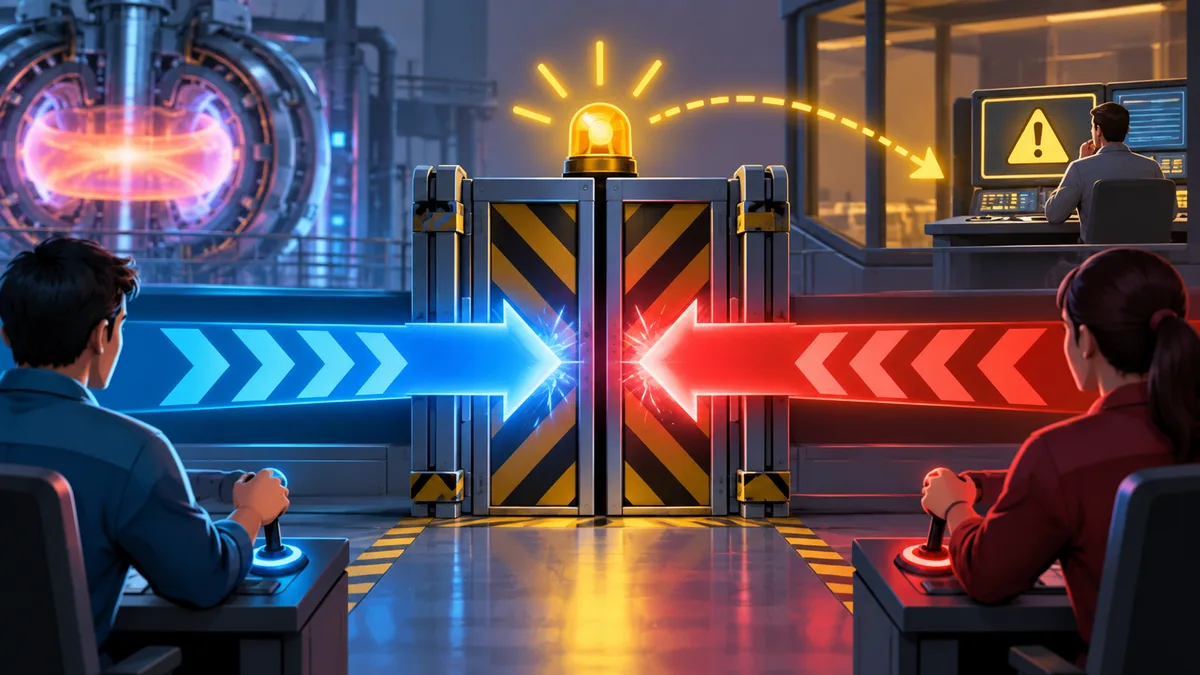
Physicists also review the results after each experiment and adjust the parameters.
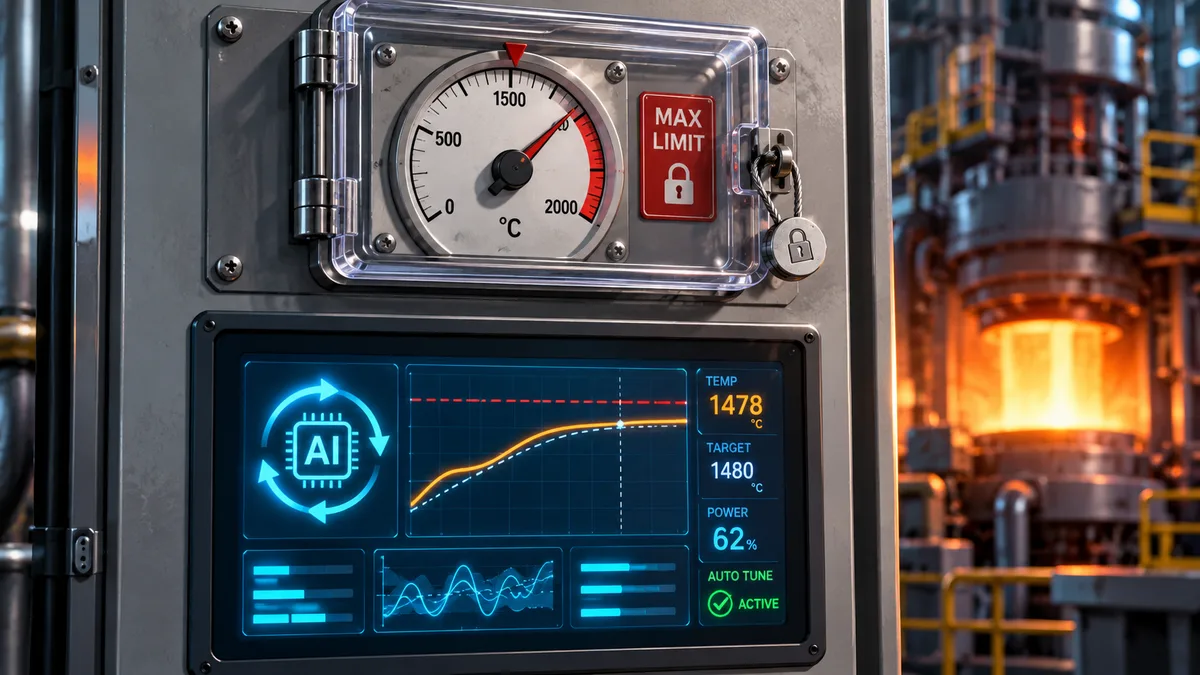
For anyone working in quality engineering, this architecture should feel familiar. An optimization algorithm can be given real control, but it should not be allowed to redefine the safety interlock.
No matter how good a system is at optimizing a furnace's temperature, it should not get to change the thermostat's upper safety limit. Optimization is supposed to find the best operating result; the safety layer is supposed to prevent outcomes beyond the defined safety limits. Put both responsibilities inside the same component, and a failure in the first can compromise the second.
This connects directly to several recent AI stories. OpenAI's published misalignment reports documented cases in which models attempted to work around tool restrictions. Google gave smart-home agents control over devices but prohibited door-unlocking actions at the server level.
PACMAN addresses a related question in an environment where mistakes can have immediate physical consequences: instead of merely trusting the model to behave correctly, design the system around what happens when it doesn't.
Why modularity matters
The framework's second notable feature is its architecture.
Models operate independently and do not communicate directly with one another. Instead, each receives the measurements it needs from a shared, structured data package. That allows a new model or controller to be added or replaced without disrupting the others.
Egemen Kolemen, who leads the group, is a professor of mechanical and aerospace engineering at Princeton, with joint appointments at the Andlinger Center and PPPL.
His point is that modularity can turn AI-based plasma control from a series of one-off demonstrations into infrastructure that the broader research community can build upon.
That distinction matters. Getting something to work once in a laboratory is not the same as creating a framework that other researchers can reproduce, extend and improve.
What the results don't tell us
There are important limits to these findings.
The work covers five experimental tests on a single tokamak. It does not mean fusion has been solved or that commercial fusion reactors are suddenly around the corner.
What it does show is that machine learning can be put to practical use in plasma control on real experimental hardware.
Nor does it establish that the system operates without human oversight. The researchers emphasize both the unconditional enforcement of hardware safety limits and physicists' review of the results after each experiment.
The takeaway
PACMAN makes headlines because it can make decisions in milliseconds. Its more important engineering contribution, however, is an architecture for placing AI inside a safety-critical control system.
Models and controllers produce decisions. A hard-coded output layer enforces the physical limits. Humans review the results and refine the system.
AI discussions often revolve around a familiar question: "How good is the model?"
In a safety-critical system, a more useful question is: What will the system do when the model gets something wrong?
PACMAN offers an answer through its architecture. That's the part of this research worth carrying into other fields.