
Technology
AI was supposed to wipe out radiology first. What happened ten years later?
In 2016, we were told to 'stop training radiologists.' Ten years later, AI really did enter radiology — but the need for radiologists did not disappear. That contradiction tells us something different about AI and jobs than many people assume.
In 2016, at a machine learning conference in Toronto, Geoffrey Hinton spoke very plainly: we should stop training radiologists immediately. In his view, within five years — ten at most — it was "just completely obvious" that deep learning would be better than radiologists at reading medical images. He compared radiologists to cartoon characters who had already run off a cliff but had not yet looked down.
Hinton was not just anyone. Today he is a Nobel laureate and one of the founding figures of modern artificial intelligence. His prediction made an impact — the late 2010s were full of articles declaring the end of radiology, and some students chose other specialties because of it.
Ten years passed. And this is the genuinely interesting part: the technology behind the prediction arrived, but the predicted outcome did not.
AI really did enter radiology
This is not a story about "AI hype turning out to be empty." According to the American College of Radiology, roughly 80% of the AI tools in the FDA's June 2026 update were intended for radiology use cases. No other medical specialty comes close. In the ACR's own survey, around 90% of members said they use AI in some form.
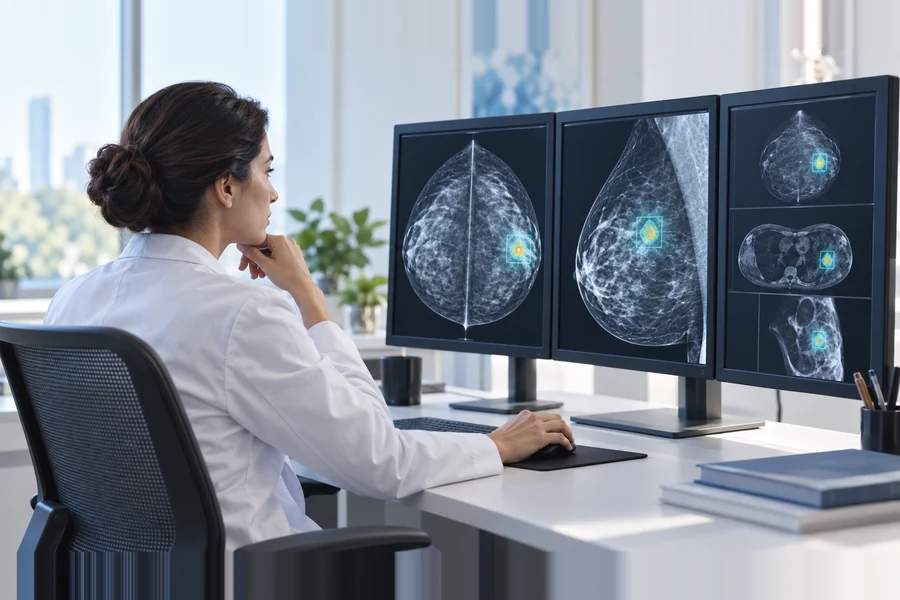
The tools work, too. In the 2026 results of Sweden's MASAI study, sensitivity in AI-supported mammography screening was 80.5%, compared with 73.8% for double reading without AI. Specificity was the same in both groups. The study's main conclusion was that AI-supported screening was at least as good as the standard method — not that it delivered some revolutionary level of superiority — but cancers detected between screening rounds were also found to have fewer adverse characteristics.
So Hinton's prediction about the technology itself was largely right.
But the need for radiologists did not decline
The expected collapse on the workforce side never happened. At Mayo Clinic's Rochester campus, one of the centers at the forefront of AI adoption, the radiology workforce has grown by 55% since 2016, reaching 400 radiologists. One institution is not proof of a national trend, of course, but it does show that intensive AI use and a growing human workforce can exist under the same roof.
The projections point in the same direction. One study estimates that the number of radiologists in the United States will grow by 25.7% by 2055 if residency positions stop expanding after 2024. If residency slots continue to grow, the same projection rises to 40.3%. In other words, even under the lower-growth scenario, the number of radiologists is still expected to increase.
The industry's current problem is not too many radiologists, but too few. In some centers, imaging appointments are backed up for months. Economic signals point the same way: in Medscape's physician compensation survey, radiologists reported average annual earnings of $571,000, up 9% from the previous year.
Hinton explains why he was wrong
Hinton has been acknowledging his mistake for some time. In 2025, he told The New York Times that he had spoken too broadly in 2016 and had not made it clear enough that he was really talking about image analysis. In an interview he gave in June this year — one that has recently started circulating again — he breaks his mistake down into two reasons.
First, demand for healthcare is elastic. When reading scans became cheaper and faster, hospitals did not simply need fewer radiologists; they started doing more scans. As the cost fell, demand increased and the total volume of work grew.
Second, he misunderstood what radiologists actually do. By his own account, he had generalized from a single example and reduced the entire profession to one narrow task. Looking at an image and spotting an abnormality is one thing a radiologist does, but it is not the whole job. Deciding what imaging should be ordered, combining the result with the broader clinical picture, talking with other physicians, carrying out interventional procedures, and ultimately taking responsibility for a diagnosis are all part of the profession as well.
Hinton now thinks he was wrong more about the timing than the direction of the prediction: AI will read a growing share of medical images, while radiologists will continue to perform the other parts of the profession.
A task is not the same thing as a job
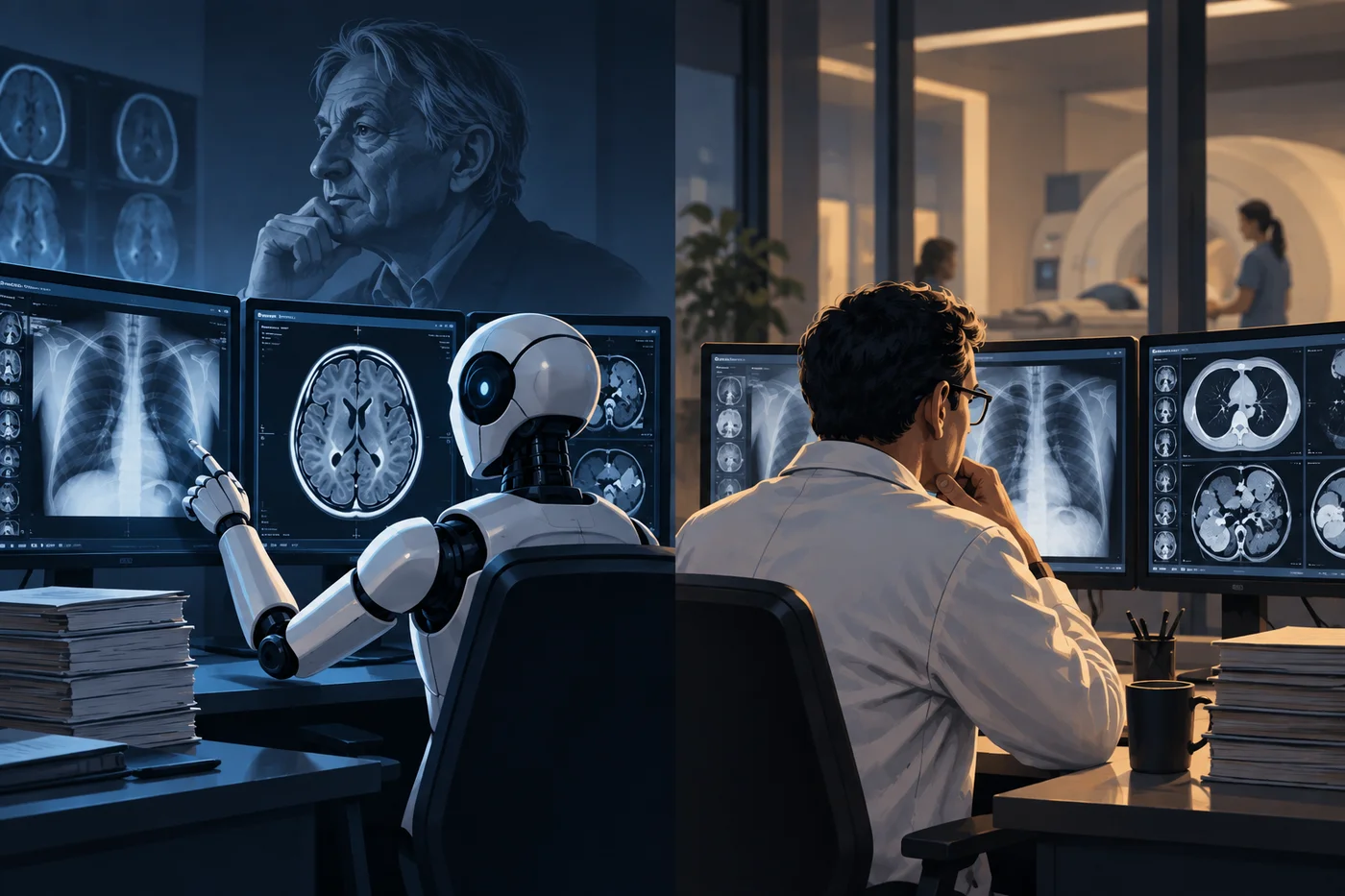
NVIDIA CEO Jensen Huang has been using this example frequently in recent months, drawing a broader distinction from it: AI automates tasks, not jobs. If a profession is made up of dozens of different tasks, automating a few of them does not necessarily eliminate the profession — in many cases, it simply makes the person doing the job more productive.
That distinction is genuinely useful. "Will AI eliminate this profession?" is about the bluntest version of the question we can ask. A better version is: which tasks within that profession will disappear, what will remain, and will what remains be enough to fill a person's working day?
But that does not mean "no jobs will disappear"
This is where some caution is necessary, because the radiology example is both reassuring and very easy to overgeneralize.
Radiology is a special case in several ways. Demand is elastic — cheaper scanning can mean more scanning. In the United States, automation arrived on top of an existing radiologist shortage; it entered a field with an unfilled gap rather than a surplus of workers. The field is also heavily regulated; someone still has to take responsibility for a diagnosis. And the cost of error is extremely high, which makes human oversight hard to remove.
A profession that does not share all four of these characteristics may produce a very different result. In a job where demand is fixed, regulation is loose, and the cost of mistakes is low, automation could translate much more directly into fewer positions.
Radiology also has problems of its own. In a 2026 American Medical Association report, 27% of physicians said they had received no training on AI, while only 11% said they had received "a lot" of training from any source. A 2023 study found that even experienced radiologists were influenced by incorrect AI suggestions, causing a meaningful drop in mammography interpretation accuracy — a phenomenon known in the literature as automation bias. In other words, even when the tool itself is good, learning how to work with it is a separate challenge.
What I take from this story
I think the main lesson here is about prediction, not radiology.
Hinton read the technology correctly and the profession incorrectly. Even someone at the very top of one field can still have an incomplete model of what people in another profession actually do. And the more confident and dramatic a prediction sounds, the more likely it is to be repeated — regardless of how close it is to reality.
We hear similar claims today about software development, translation, accounting, law, and other fields. When I hear them, the question I find myself asking is this: does the person making the prediction really understand the job up close, or are they looking at its most visible task and mistaking that task for the whole profession?
The same question applies to my own work. In quality engineering, it seems entirely plausible to me that AI will take over parts of data collection and reporting. But walking onto the production floor to understand why a line stopped, talking to the operator, and taking responsibility for what happens next are different things. Maybe I am making the same mistake in reverse in my own field — and the only way to know for sure may be to wait another ten years.