
Technology
Is AI making computer parts more expensive? What’s happening with RAM and SSDs?
RAM and SSD prices are much higher than they were two years ago, and AI is often blamed. The connection is real, but it is not as direct as it sounds — there are several steps in between.
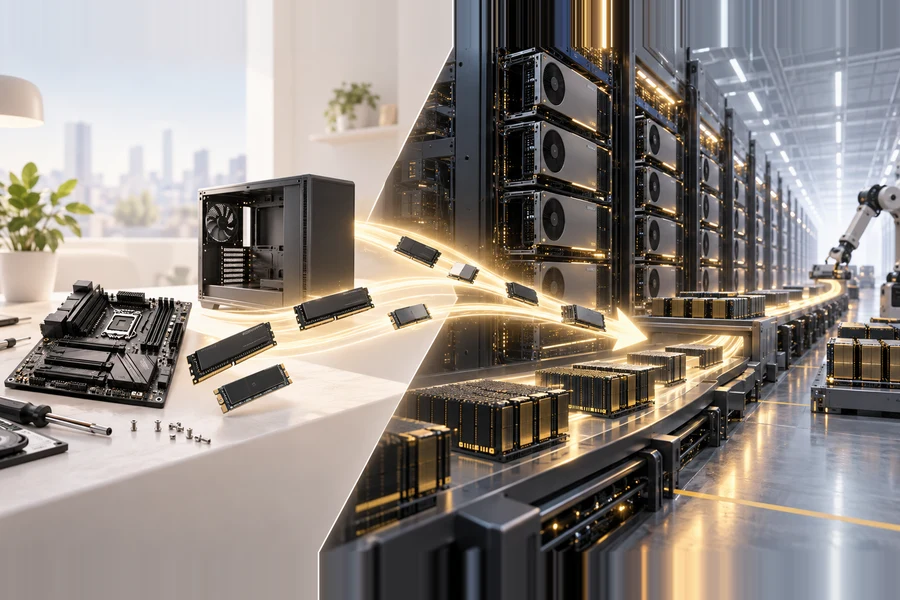
Anyone who has built a PC or upgraded a component recently has probably noticed it: RAM prices are no longer in the same world they were two years ago. SSDs have climbed as well.
And everywhere, you see the same explanation: because of AI.
That answer is largely correct — although AI is not the only factor. Cyclical production cuts, low inventories, and process transitions also matter. But one of the biggest new sources of pressure in recent years has come from AI, and a few important steps are often skipped in the explanation. At first glance, the connection can even seem illogical. The AI servers in data centers do not use the same RAM sticks I put into my PC. They are different products. So where is the link?
First, let’s separate two things: HBM and DDR5 are not the same
AI accelerators use a type of memory called HBM, or high-bandwidth memory. It is a specialized product built from stacked memory layers and placed very close to the processor.
That is not the DDR5 module you plug into a desktop motherboard. Different design, different manufacturing process, different customer.
So the phrase “AI is taking away our RAM” is not literally true. Nobody is buying the exact memory kit you were going to put in your PC.
The connection is production capacity
They are different products, but they both draw from the same limited pool of DRAM manufacturing capacity.
Most of the world’s DRAM market is controlled by three companies. According to TrendForce data for the second quarter of 2026, Samsung held 39.4% of the market, SK hynix 24.9%, and Micron 23.3% — roughly 88% combined. These companies have finite production capacity, and they decide how to allocate it across different products.
This is where the key difference appears: HBM consumes much more manufacturing capacity to produce the same amount of memory. Micron describes the trade-off as roughly 3 to 1 — in other words, producing the same bit capacity as HBM can require around three times as much production capacity as DDR5.
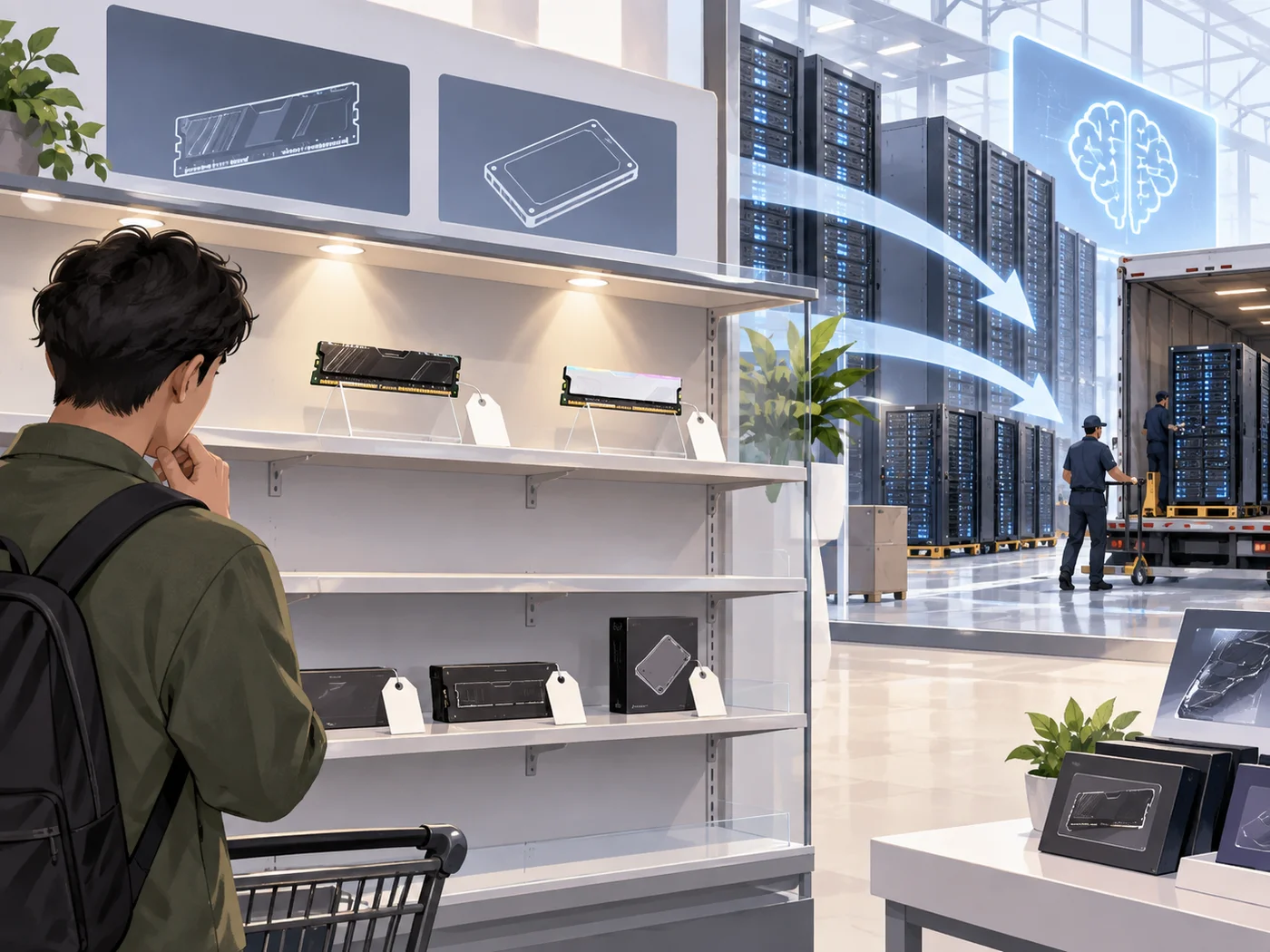
Then add server demand on top. Data centers do not buy HBM alone; they also consume server DRAM and enterprise SSDs. As a result, much of the industry’s incremental capacity is being directed toward servers, while the share left for consumer memory is squeezed.
So the chain looks like this: AI and server demand → capacity shifts toward those products → less capacity is allocated to consumer memory → prices rise. The relationship is indirect, but it is real.
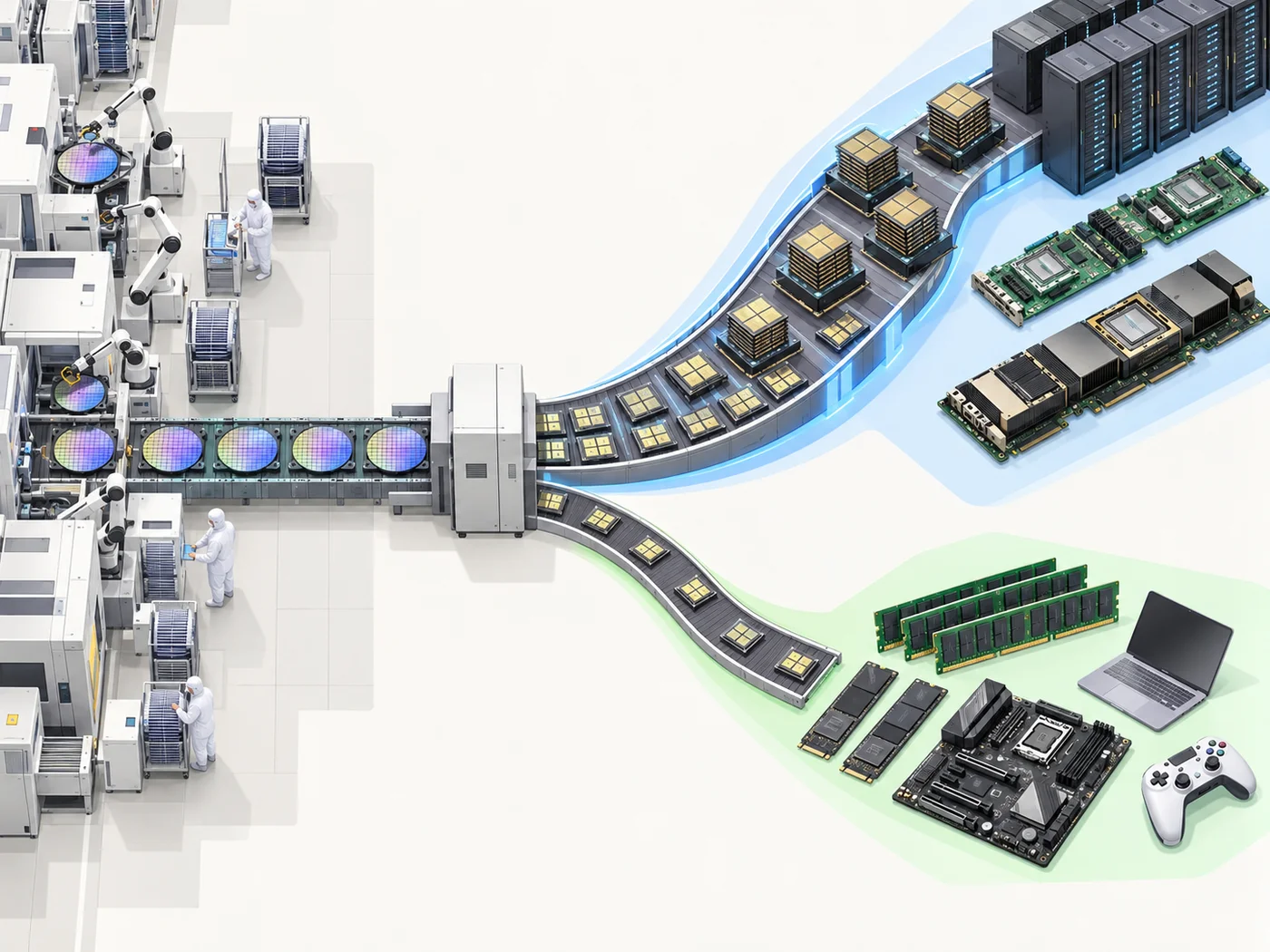
There is also a common misconception worth correcting. This shift is often explained as “HBM is simply much more profitable.” In 2026, the picture is not that simple. TrendForce data shows that in the first quarter of the year, HBM’s revenue per wafer had fallen below that of some DDR5 server modules. The issue is less about a universally superior margin and more about capacity economics.
What do the numbers say?
According to J.P. Morgan research, DRAM prices are expected to rise by more than 400% from the beginning of 2024 to the end of 2026.
The size of the market points in the same direction. TrendForce says DRAM industry revenue rose 59.5% quarter over quarter in the second quarter of 2026 — not because supply suddenly expanded, but because supply continued to lag behind demand.
There are also wildly different estimates for how much of global memory production is being absorbed by data centers. Those figures often measure different memory types and different market segments, so they are not directly comparable. Rather than anchoring on a single percentage, it is more useful to focus on the underlying mechanism.
The clearest signal is not a percentage
To me, the clearest signal is this: Micron exited its consumer brand, Crucial.
The decision was announced on December 3, 2025, and shipments continued through February 2026. Crucial had been one of the most familiar names in PC building for years. Micron was also explicit about why it was leaving the business: to allocate more supply to AI-driven data center demand.
When a manufacturer shuts down a consumer brand, that says something about how high consumer products rank in its priorities — often more clearly than another market-share chart.
It is not just RAM
The pressure is not limited to one product category.
NAND flash — the memory used in SSDs — is facing similar pressure. According to TrendForce, enterprise SSD demand from AI servers created supply tightness in the NAND market during the second quarter of 2026. At the same time, manufacturers’ investment priority has shifted toward DRAM and HBM, limiting how quickly new NAND capacity can come online.
Prebuilt PC makers are responding as well. Dell, Acer, and ASUS have reportedly raised prices because of higher memory costs, while Acer’s chairman said material costs had risen sharply for some products.
There is also an ironic loop here: AI is helping push memory prices higher while, at the same time, AI features are making devices need more memory. On-device assistants, local model inference, real-time translation — all of them need RAM. Memory is getting more expensive just as the amount we want is going up.
Is this simply a shortage, or something else?
There is an uncomfortable question here, and ignoring it would leave the picture incomplete.
When three companies control roughly 88% of a market, prices do not necessarily need explicit coordination to remain high. In such a concentrated industry, tight supply can support elevated prices even without companies talking to one another.
That said, there is currently a class-action lawsuit accusing the three major DRAM manufacturers of coordinating supply and pricing. The companies are seeking to have the case dismissed, and the allegations have not been proven.
The industry also has history here. In the DRAM price-fixing investigations of the 2000s, Samsung and Hynix pleaded guilty, alongside other manufacturers including Infineon and Elpida. Micron, however, was not convicted as a company of DRAM price fixing.
I am not presenting the current allegations as established fact. But it would also be too simplistic to treat “supply and demand” as the only possible explanation for pricing behavior in such a concentrated market.
What about Turkey?
For buyers in Turkey, the question is a little more complicated: how much of the increase comes from global memory prices, and how much comes from the exchange rate?
There is a simple way to separate the two. Take the price of a component in Turkish lira, divide it by the USD/TRY exchange rate from the same period, and compare the dollar-denominated price across two dates. If the exchange rate rises by around 40% while the component’s TL price triples, then the full increase cannot be explained by currency depreciation alone. The gap may reflect global memory prices, inventory conditions, distribution costs, local pricing, or a combination of these factors.
When I apply this method to components I have followed myself, a meaningful part of the increase remains even after adjusting for the exchange rate. In other words, Turkish buyers are paying for two effects at once: the depreciation of the lira and the global rise in memory prices.
There is also a local factor. Turkey has a shallower retail market and fewer sellers for some components, so a single model can easily drift away from the broader market. If one product suddenly becomes much more expensive, that does not necessarily mean the entire category has moved by the same amount — checking several comparable models gives a more reliable picture.
When will it get better?
The short answer: probably not soon.
Manufacturing capacity cannot be expanded overnight. New fabs take years to build, and the industry reduced investment during the 2022–2023 downturn — meaning it was not prepared for the surge in AI-related demand that followed in 2025.
TrendForce expects structural tightness in DRAM to persist through 2027, while NAND supply may begin to ease in the second half of 2027. In other words, storage could normalize before memory does.
That leaves consumers with limited options. If you are building a PC today, the strategy of “I’ll wait a little and buy when it gets cheaper” may not work particularly well in this cycle; many forecasts still point to further price pressure before conditions improve.
What I take from this
The sentence “AI made RAM more expensive” is true, but incomplete.
A more accurate version is this: AI companies are not buying the DDR5 kit you were planning to put into your desktop. But the money they are spending on HBM, server DRAM, and data center SSDs is changing how the same manufacturers allocate scarce production capacity. Consumers are paying the downstream cost of that decision.
In short, AI has pushed the consumer market further down the priority list for memory manufacturers.
That distinction matters. One interpretation sounds like a temporary demand spike. The other looks more like a structural shift in priorities — and if that is the case, prices may not fall simply because demand cools. They may only come down once capacity genuinely expands.
Micron’s decision to retire the Crucial brand is, to me, one of the clearest signs that the second interpretation is worth taking seriously.