

Games
DLSS 5 doesn’t boost FPS — it reinterprets the image. Is it worth it?
DLSS has spent years being associated with higher performance. DLSS 5 does the opposite: it can significantly reduce frame rate in exchange for reinterpreting how the game looks. That is where the controversy begins.
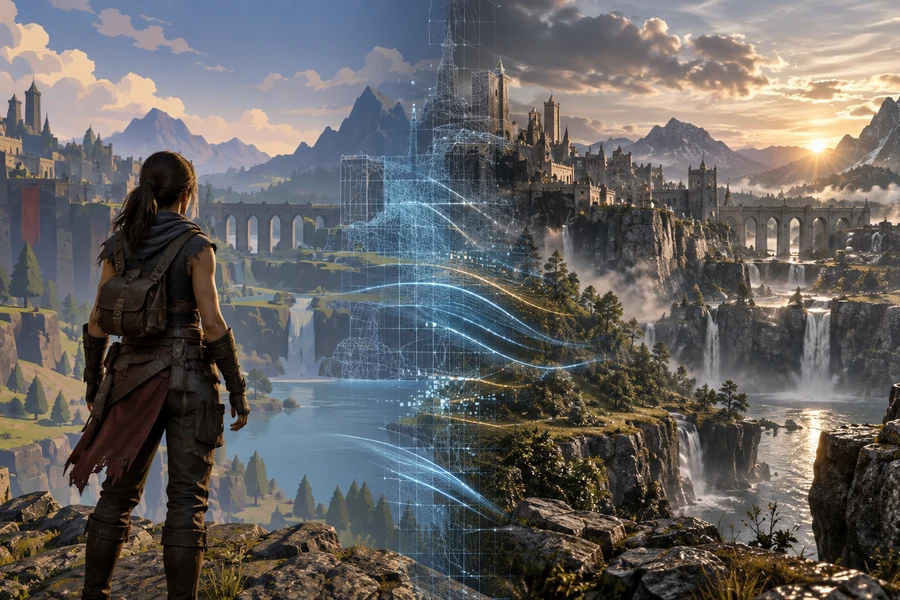
DLSS 5 launched on September 3. NBA 2K27 is currently the only game with official support, and the technology only works on the RTX 50 series.
And it does the opposite of what we have come to expect over the past decade.
Until now, the usual idea behind DLSS was simple: run the game at a lower resolution, let AI upscale it, and gain performance. DLSS 5 changes that equation — in the first independent tests, DLSS 5 by itself can reduce frame rate by roughly 50–60%. That figure does not come from NVIDIA; in its own marketing, the company shows DLSS 5 together with Super Resolution and Frame Generation and reports the combined frame rate.
Either way, this is not a performance feature. It exists for image quality.
What exactly does DLSS 5 do?
NVIDIA calls it "3D-guided neural rendering." The difference from previous versions is this: instead of filling in missing pixels, it recreates the lighting and material appearance of the scene.
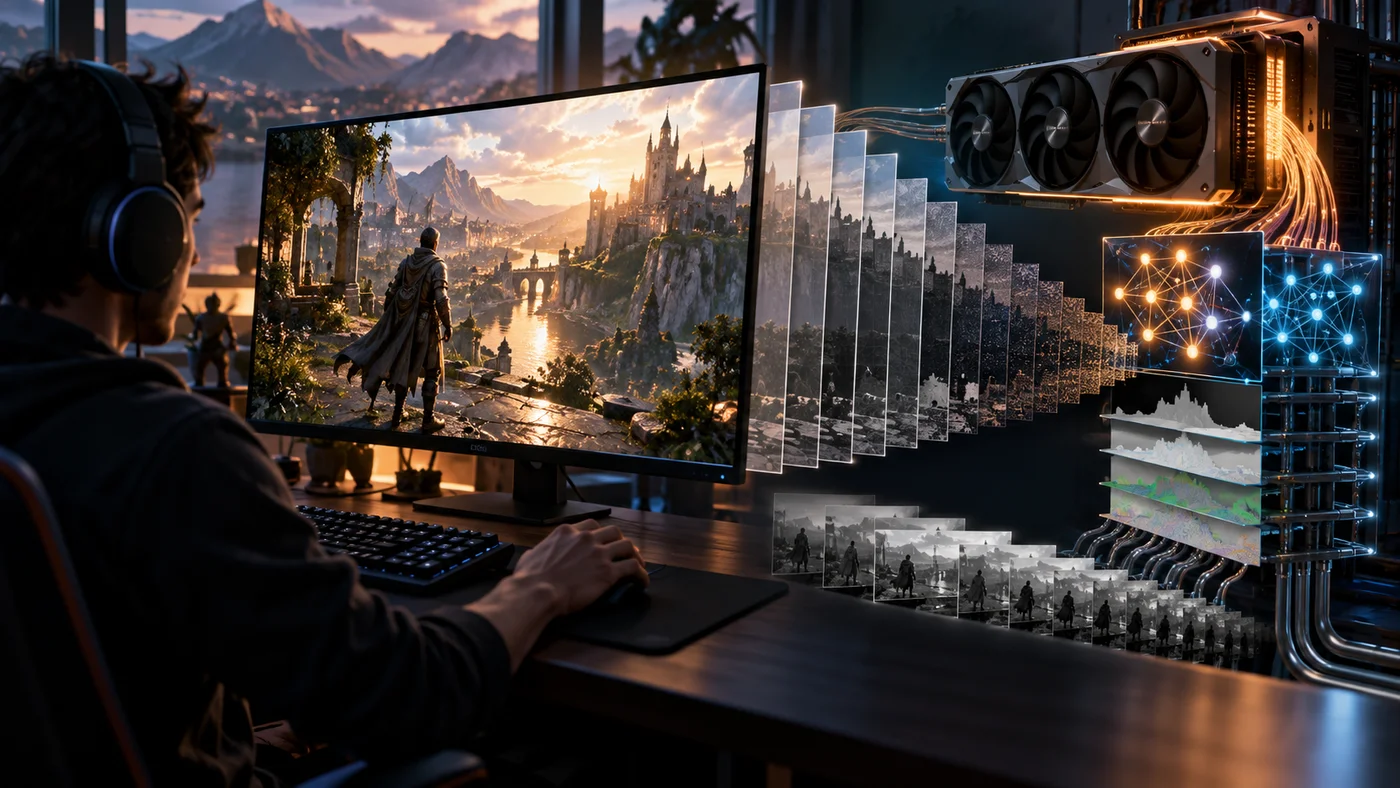
The model takes the frame rendered by the game along with engine data such as color, motion vectors, lighting, and surface information. It then rewrites elements such as skin translucency, fabric reflections, hair behavior, and ambient lighting according to its learned concept of photorealism.
One frame goes in, one frame comes out. There is no generative randomness; NVIDIA emphasizes that the model remains temporally consistent from frame to frame. Developers can choose between different models, control the strength of the effect with settings such as "structure intensity" and "tone intensity," and even mask specific objects in the scene.
The difference is not just technical — it is philosophical
A line from one of NVIDIA's technical presentations captures the distinction well: every previous DLSS version had a ground-truth reference. The target was known — get as close as possible to the image rendered at full resolution. That is why the process was called reconstruction.
DLSS 5 does not have that kind of reference.
Think about what that means. Previous versions were effectively saying, "this is what the image was supposed to look like, and I am trying to reproduce it." Their success could be measured against a target. DLSS 5 is closer to saying, "this is what the image looked like, but it could be more realistic." The measure of success is no longer a fixed target, but the model's own interpretation of photorealism.
That is where the fight began
When the technology was introduced at GTC in March, the backlash came quickly. A comment under the launch video saying, "now your game can look like AI art too," received more likes than the video itself.
The core criticism is that the model smooths faces, "beautifies" characters, and shifts lighting away from what the art direction intended. Character faces in the Resident Evil Requiem and Hogwarts Legacy demos were especially controversial. The phrase that spread online was "AI slop."
Developers did not stay silent either. Bethesda felt the need to stress that its own artists would remain in control, while Capcom was reported to have been unaware of the demo. In a TechPowerUp poll of roughly 20,000 readers, 58% said AI should not alter games at all.
NVIDIA CEO Jensen Huang responded directly to the criticism, saying the critics were "completely wrong." His argument was that developers retain full control over geometry, textures, and generative elements, and that this is not ordinary generative AI but a "content-controlled" system.
The most interesting admission comes from NVIDIA itself
The most revealing document in this debate is not an angry player post, but NVIDIA's own research paper.
The paper explicitly states that the current version of DLSS 5 is limited to photorealistic rendering. More importantly, it acknowledges that voxel-based, illustrative, or cartoon-styled games deliberately use non-photorealistic visual languages, and that applying DLSS 5 to this kind of content could work against the art direction instead of improving it.
A more general system capable of transforming the image according to a developer's intended style is listed as future work. In other words, that system does not exist yet.
That amounts to NVIDIA's own research team acknowledging the strongest version of the criticism. Huang says the critics are "completely wrong," while the company's researchers explicitly accept that the concern can be valid for certain kinds of games.
So who is it for?
I think the technology itself is impressive, and the controversy is not overblown. Both things can be true at the same time.
The place where DLSS 5 makes the most sense is obvious: games that already aim for photorealism. NBA 2K27 being the first supported title is not a coincidence — making basketball players look more realistic does not fight against the art direction; it follows it.
But the same may not be true for a game that deliberately uses grainy, dark, or highly stylized visuals. And that is not just my opinion; NVIDIA's own paper says so.
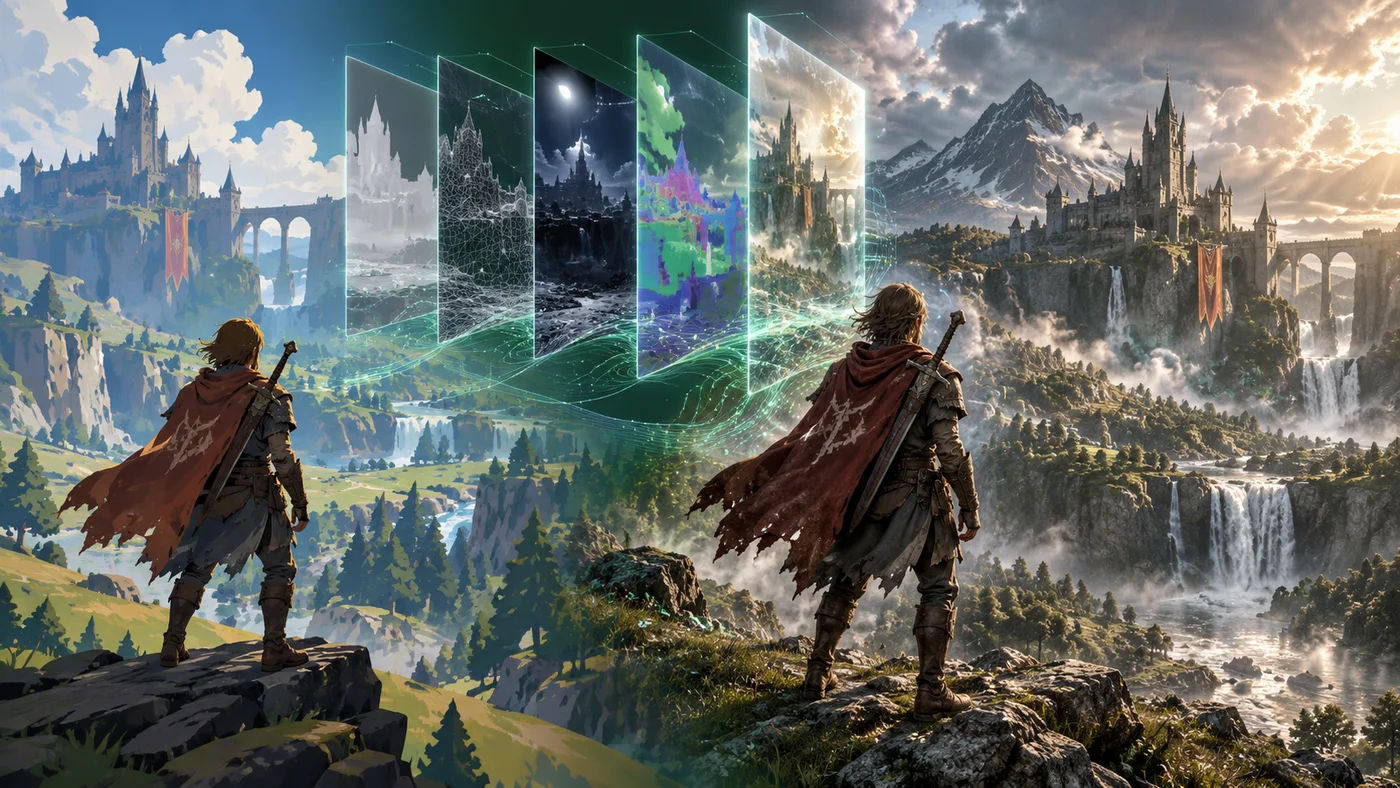
The real question is: how much frame rate would you give up for this image? A loss of up to around 50% in testing is not trivial. A game running at 60 fps can fall toward 30 fps. To compensate, you may need to enable other DLSS features such as Super Resolution and Frame Generation — creating an odd loop where AI gives you back the performance that another AI feature took away.
The hardware side
In NVIDIA's current support table, 3D-guided neural rendering is listed only for the RTX 50 series, including desktop and laptop GPUs from the RTX 5050 through the RTX 5090. The RTX 40, 30, and 20 series are not currently supported.
Support for the RTX 40 series has been discussed as a future plan: NVIDIA wants to optimize the model on RTX 50 first, then work on RTX 40. There is no date. No official plan has been announced for RTX 30 or RTX 20.
The engineering achievement here is still worth acknowledging. The first demo in March ran on two RTX 5090s. In six months, the model was accelerated by a factor of five and made to run on a single GPU, including the lower-end models in the RTX 50 lineup. More optimization is expected in the fall.
According to NVIDIA, the model can now run in real time at up to 4K on a single GPU.
What I take from this
I think asking whether DLSS 5 is "good or bad" is the wrong question. A better one is: is this still a rendering technology, or has it become an interpretation layer?
Previous DLSS versions did not really stand between you and the game. They tried to reproduce the image the game wanted to draw, only more efficiently. DLSS 5 steps in and effectively says, "this might look better if we did it this way."
That is not necessarily a problem as long as it remains an optional setting. The real concern would be if, a few years from now, games begin to be designed with this layer assumed by default. At that point, turning it off could leave you with what feels like the incomplete version of the game.
We are not there yet. But it is worth remembering that this technology became five times faster in just six months.