
$2,195 Snap Specs Are Up for Preorder — but Snap Still Won't Tell Us the Resolution
Snap's new AR glasses are up for preorder. The specs it has revealed are interesting; the ones it hasn't may be even more important. Resolution, brightness, refresh rate, RAM, and battery capacity are still undisclosed — and one of those missing figures directly relates to an issue reviewers noticed in hands-on testing.
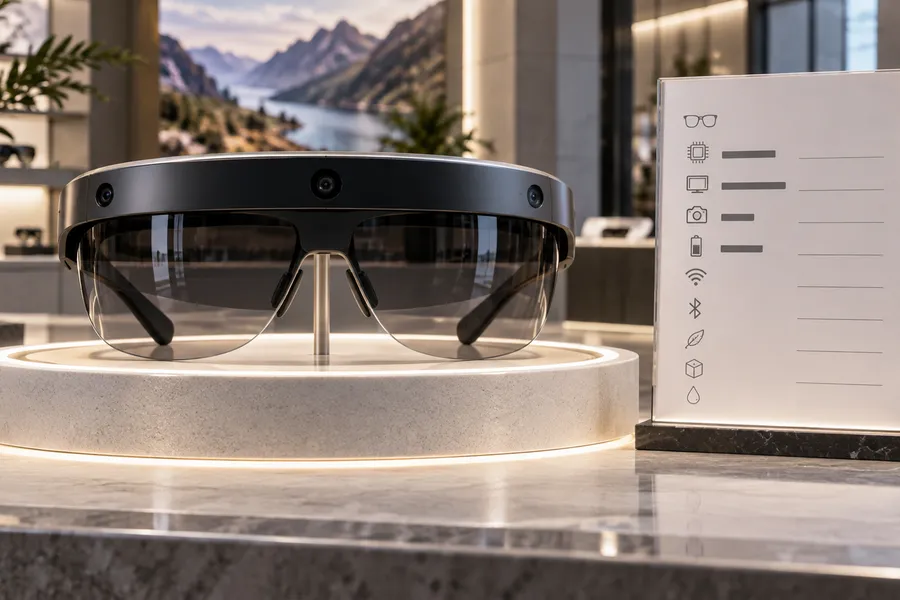
Snap gave a more detailed look at its next-generation AR glasses, Specs, during its September 16 launch event after first announcing the product in June.
The price is $2,195, with a refundable $200 deposit required to preorder. Shipments are expected this fall, starting in the United States, United Kingdom, and France.
This is not a hobbyist development kit. It is a consumer product.
And yet, once you try to evaluate it, you run into a strange problem: a significant part of the spec sheet is still missing.
What Snap has disclosed
| Specification | Value |
|---|---|
| Field of view | 51° diagonal |
| Display technology | LCoS |
| Color | 16 million colors |
| Motion-to-photon latency | 7 ms |
| Processor | Dual Qualcomm Snapdragon |
| Weight | 132 g (47 mm) / 136 g (52 mm) |
| Battery | 4 hours mixed use, up to 20 hours with case |
| Lenses | Electrochromic, tint in ~10 seconds |
| Input | Hand tracking via two cameras |
| Frame | TR90 polymer |
Some of these numbers are genuinely ambitious.
A 7 ms motion-to-photon latency is a serious engineering target, and electrochromic lenses make practical sense for a device meant to move between indoor and outdoor environments.
The 51-degree field of view is also an improvement over the previous generation's 46 degrees.
What Snap hasn't disclosed
According to spec roundups from Road to VR and TechTimes, several basic details remain unknown:
- Display resolution
- Brightness, in nits
- Refresh rate
- RAM and storage
- Camera specifications
- Wireless connectivity standards
- Water and dust resistance
- Battery capacity in mAh
Those details are still missing.
The preorders, meanwhile, have been open since June.
TechTimes makes a useful comparison: it is a little like buying a television without knowing its resolution.
It also makes generational comparisons difficult. The previous Spectacles delivered 37 pixels per degree. We do not yet know whether the new Specs improve on that number.
What hands-on reviews found
The publications that tried the hardware at Snap's event offer more useful information than the marketing copy.
The field of view is still narrow. In Gizmodo's demo, 51 degrees was not enough to keep all digital objects comfortably within view. During one game, the writer struggled to locate objects because some were literally "off to my left, out of my field of view." Engadget similarly noted that content could be clipped at the edges of the display.

Image quality depends on ambient light. Engadget described the display as generally bright and easy to see, but noted that image quality changed with lighting conditions and looked somewhat sharper in darker environments.
Hand tracking can be sensitive. Hair falling in front of the tracking cameras caused the cursor to jump.
Motion introduces blur. Gizmodo observed noticeable blur when trying to follow interface elements while walking.
Weight remains an open question. The smaller model weighs 132 grams — nearly twice as much as Meta's display-equipped smart glasses, according to Engadget's comparison. Gizmodo said the glasses felt lighter on the face than expected but put more noticeable pressure around the ears, though that remained manageable during a short session. Engadget reported no discomfort during roughly 20 minutes of use and said the weight was distributed well across the head.
Long-term comfort is still unknown.
And visually, these are still much larger than ordinary glasses.
There is an interesting overlap here
One of the specifications Snap has not disclosed is display brightness.
One of the things reviewers noticed is that image quality changes depending on ambient lighting.
We cannot know whether those two facts are related in any deliberate way, and I am not suggesting that they are.
But the practical result is simple: one of the basic numbers needed to compare how this display performs across different lighting conditions is not available when the buyer is being asked to make a purchasing decision.
There is a familiar quality-control principle here:
You cannot make an acceptance decision without acceptance criteria.
In incoming inspection, you would not approve a part without knowing what value the drawing or specification requires. You would not say, "We'll measure it later."
Putting a $2,195 device up for preorder without disclosing its resolution or brightness effectively asks the customer to do exactly that.

This does not mean Specs is a bad product.
It may be excellent.
The point is simpler: right now, we cannot know, because some of the numbers needed for a meaningful comparison are missing.
What about Specs Intelligence?
Snap also announced an AI service called Specs Intelligence at the same event.
The company describes it as an anticipatory service that can connect to external accounts such as Google and surface timely, context-aware information — for example, reminders, questions to ask before a meeting, or travel-related suggestions.
On the glasses, it can be invoked with "Hey Specs," with information appearing directly in the user's field of view.
The service is not limited to the glasses either. Snap is also offering versions through iOS and Mac.
Expectations still need to be kept in check.
In Engadget's demo, the full Specs Intelligence experience was not yet available. The "Hey Specs" voice command did work, however, and could be used to open a browser window.
The rollout is also staged.
In the U.S., there is currently a limited preview on iOS that lets users connect their Google account and see insights into where their time and attention are going. That version does not yet include proactive suggestions.
The broader early-access version, which does include proactive recommendations, is initially being offered on Mac by invitation.
The business risk is just as interesting
Specs is not just another hardware experiment for Snap.
The company has been here before.
In 2017, Snap wrote down $39.9 million in inventory tied to roughly 300,000 unsold Spectacles after badly overestimating demand.
This time, the same questions are returning in a different form: price, wearability, and whether enough people actually want the device.

There is also pressure from investors.
Activist investor Irenic Capital has urged Snap to consider either shutting down the Specs business or spinning it off into a separate company, arguing that broader changes could increase Snap's value by "at least five times."
Reports say Snap has already spent more than $3.5 billion on the business.
CEO Evan Spiegel has pushed back, saying the company remains committed to its long-term strategy. Snap also moved the Specs business into a separate subsidiary in January, leaving the door open to outside financing in the future.
So the $2,195 price is not only a bet for the consumer.
It is a bet for Snap as well.
Conclusion
Snap Specs looks like a device that deserves to be taken seriously from an engineering standpoint: 7 ms latency, dual Snapdragon processors, electrochromic lenses, and standalone operation.
Conceptually, it is far more ambitious than the relatively simple smart-glasses approach Meta has taken.
But evaluating a product is not the same thing as listening to its claims.
The numbers Snap has disclosed tell us what the device is trying to achieve.
The numbers it has not disclosed are the ones that would help tell us whether it actually achieved it.
Making the decision without those numbers is less like buying a product and more like placing a bet.
If Snap publishes the missing specifications before shipments begin, the picture will become much clearer.
If it does not, that will be information too.