

Who Pays AI's Electricity Bill? What the 417–3 Data Center Bill Solves — and What It Doesn't
The U.S. House passed a bill aimed at preventing data center infrastructure costs from being shifted onto ordinary ratepayers by a 417–3 vote. A day later, an attempt to fast-track it through the Senate by unanimous consent was blocked. The numbers explain the broad agreement; the mechanism shows why the underlying problem is far from settled.
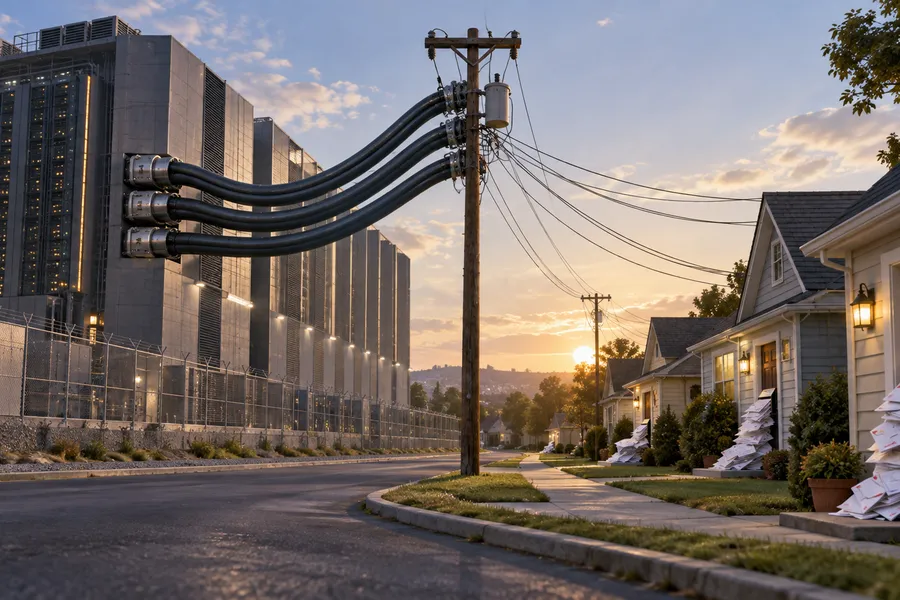
On September 16, the U.S. House of Representatives passed a bill aimed at preventing data centers from shifting electricity infrastructure costs onto ordinary ratepayers.
The vote was 417–3.
That is an unusually broad bipartisan margin in today's U.S. politics. But the picture changes once you look at how the bill actually works: it does not impose a binding federal rate structure.
The consensus is largely over the diagnosis, not the solution.
What happened in the Senate the next day made that even clearer.
Why did the bill attract such broad support?
The answer starts with the numbers.
In PJM — the regional grid operator serving 13 states and the District of Columbia, and the largest electricity market in the United States — capacity prices have surged over the past two years.
| Capacity year | Price ($/MW-day) |
|---|---|
| 2024/2025 | $28.92 |
| 2025/2026 | $269.92 |
| 2026/2027 | $329.17 |
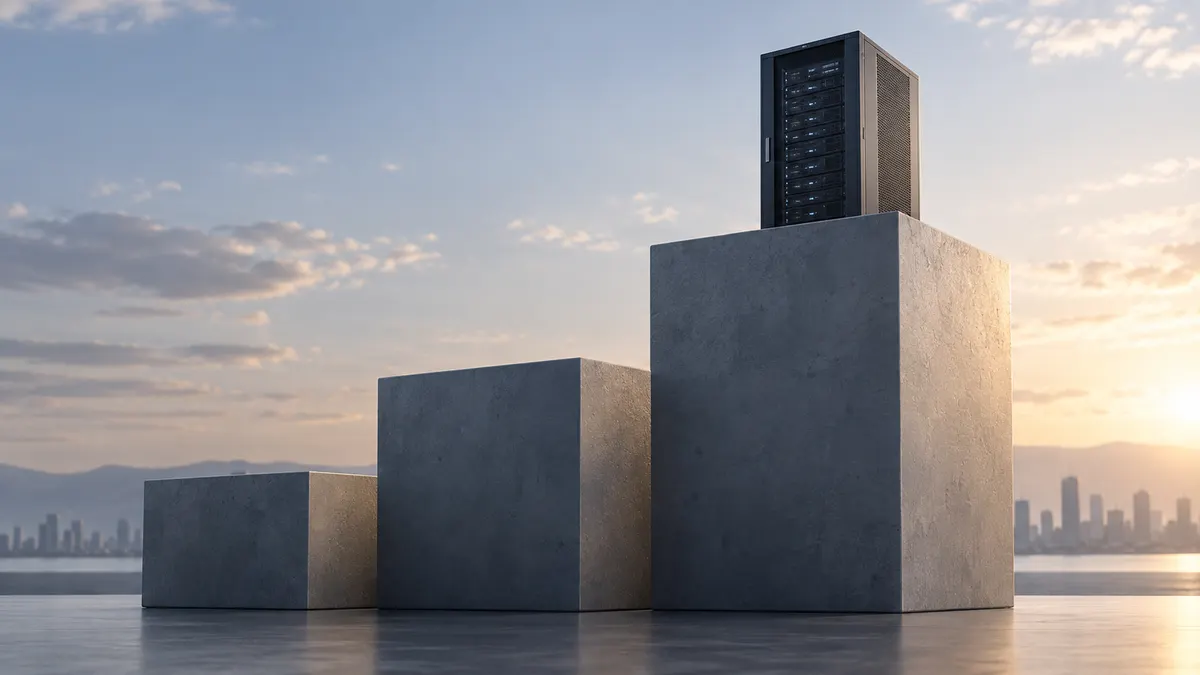
That is roughly an elevenfold increase in two years.
Total wholesale power costs have also climbed sharply. According to The Register, citing Monitoring Analytics, PJM's total wholesale cost per MWh rose from $77.78 in the first quarter of 2025 to $136.53 in the first quarter of 2026 — an increase of roughly 75%.
That figure includes components such as energy, capacity, and transmission. It is not simply the spot price of electricity.
The portion linked to data center growth is not just speculation. It comes from the market's independent monitor.
According to IEEFA's summary of Monitoring Analytics' analysis, data centers accounted for roughly 63% of the increase in the 2025/2026 capacity auction price. Monitoring Analytics separately estimated that data center load added about $9.3 billion to capacity market revenues.
The same analysis argues that, without projected data center growth, the capacity market would not have tightened to the same degree.
The effect on household bills is not abstract either.
Regional estimates cited by IEEFA put the monthly increase at around $21 in Washington, D.C. — about $10 of that tied to capacity costs — $18 in Maryland, and $16 in Ohio.
That cost pressure helps explain why the bill attracted such overwhelming bipartisan support.
What does the bill actually do?
H.R. 9340, the Ratepayer Protection Act, does not create a new federal electricity tariff.
Instead, it uses an existing mechanism under Section 111(d) of the Public Utility Regulatory Policies Act, or PURPA.
The bill defines a category of "large-load customers" covering commercial users operating data storage and computing infrastructure, and limits the relevant threshold to facilities or campuses with at least 100 megawatts of total peak electricity demand at a single location.
In other words, the threshold applies per facility or campus.
The bill does not legally declare these customers to be a separate ratepayer class. It defines which large loads would fall under a proposed cost-recovery standard.
If the bill becomes law, state regulatory authorities and covered nonregulated electric utilities would have to begin considering the standard — or set a hearing date — within one year, and complete the process within two years.
But they would not be required to adopt it.
That is the key point.
The House is forcing states to put the issue on the agenda. It is not dictating the outcome.

TechTimes points to previous PURPA standards as a useful precedent. During the 2005–2007 period, for example, states were required to consider energy-efficiency and smart-grid standards, but many ultimately chose not to adopt them.
The bill also exempts jurisdictions that have already implemented a similar standard, formally considered one, or voted on one in a state legislature before the federal provision takes effect.
TechTimes cites Virginia, Oregon, Ohio, and Oklahoma as examples. The House Energy & Commerce Committee says similar protections are already in place in 24 states.
That 24-state figure comes from the committee's own statement, not from the text of the bill itself.
The criticism isn't that the bill goes too far — it's that it doesn't go far enough
There is an easy detail to misread here.
The three House members who voted against the bill were Summer Lee, Rashida Tlaib, and Delia Ramirez.
Tlaib said the measure did not "meaningfully protect our communities."
I could not verify primary-source explanations from Lee and Ramirez, so I would not attribute the same reasoning to all three.
But similar criticism also came from lawmakers who voted for the bill.
Rep. Veronica Escobar supported the measure, then described it as the "absolute bare minimum."
Rep. Frank Pallone also voted yes while calling the bill "imperfect" and only a small part of the broader problem.
Harvard Law School's Ari Peskoe framed the technical issue clearly: voluntary commitments by companies are not enough on their own, because electricity rates are ultimately set by state regulators.
What happened in the Senate?
The House's 417 votes did not mean the bill would move just as easily through the Senate.
On September 17, Republican Sen. Jon Husted tried to pass the bill quickly by unanimous consent.
Under that procedure, a single senator can stop the request.
Democratic Sen. Martin Heinrich did exactly that.
His objection was again that the measure did not go far enough. Heinrich argued that it failed to adequately address data center-related costs, meaningful community participation, water use, and air pollution.
He said Congress needed to pass legislation with "real teeth."
He then tried to advance his own proposal, the GRID Savings Act, through the same unanimous-consent process.
This time, Republican Sen. Bernie Moreno objected. Moreno argued that Heinrich had reinforced criticism of a dysfunctional Congress by blocking the House-passed bill and then asking the Senate to pass his alternative.
There is also a separate Senate version of the Ratepayer Protection Act — S. 5028 — introduced on July 16 and currently pending before the Senate Energy and Natural Resources Committee.
An important distinction: the House bill was not defeated in a final Senate vote.
What was blocked was an attempt to fast-track it through unanimous consent. The measure can still move through other Senate procedures.
Even so, the political picture is revealing: a bill that passed the House almost unanimously was stopped by a single objection the next day — and the competing alternative was then blocked in exactly the same way.
The real issue isn't morality. It's rate design.
It is easy to frame this story as "big tech companies are bad."
But the more interesting problem is much more mundane — and more solvable:
Who pays for the infrastructure?
Electricity tariffs distribute grid costs across different classes of customers.
If a utility has to build hundreds of megawatts of new generation, transmission, or local infrastructure to serve one exceptionally large customer, the technical question is straightforward:
Should that customer bear the cost, or should the expense be pooled and spread across everyone else's bills?
For anyone who works in quality or manufacturing, the logic is familiar.
If you expand a production line to handle the requirements of one specific order, you can bury that investment inside overall production costs.
Accounting may allow it.
But from a decision-making perspective, it creates the wrong signal.
If the party generating the cost never sees that cost, the same decisions will continue to be made.
Assigning the cost to its source is not necessarily punishment. It is a way of producing a more accurate economic signal.

That is what the bill's 100 MW threshold is trying to address: treating unusually large loads differently for the purposes of cost recovery.
Whether that approach ultimately works would depend — if the bill becomes law — on what state regulators actually decide to adopt.
What about Turkey?
This debate has not reached the same intensity in Turkey yet, but the scale is beginning to matter.
According to Anadolu Agency's September 4 reporting on Turkey's AI Action Plan, the country's 2030 targets include at least $10 billion in investment across data center, cloud, and AI infrastructure; 1 gigawatt of installed AI data center capacity; and 10 terawatt-hours per year of low-carbon power purchase agreements.
The plan also calls for at least 60% of the electricity supplied to data centers to come from low-carbon sources.
The scale comparison needs to be handled carefully.
Turkey's 1 GW figure is a nationwide target for total AI data center capacity.
The U.S. bill's 100 MW threshold, by contrast, applies to a single facility or campus.
The two numbers are therefore not directly comparable.
What is still worth watching is how grid reinforcement costs will be allocated as large data center projects arrive.
The source used here does not spell out how those costs would be shared — the same question now being debated in the United States.
That does not mean Turkey's broader policy framework contains no such rules. It simply means they are not addressed in the material covered here.
And the distinction matters: the carbon intensity of the electricity supply and the allocation of grid infrastructure costs are two separate policy questions.
Conclusion
The 417–3 House vote shows broad agreement on one point:
AI infrastructure creates electricity costs, and some of those costs are currently being passed on to ordinary ratepayers.
But the bill itself does not reallocate those costs.
It requires regulators to formally consider the issue.
That difference matters.
Recording a deviation is the first step in any process. But if the corrective action is left to someone else, the outcome is not guaranteed.
And the bill is not law yet.
It passed the House, but the first attempt to fast-track it through the Senate was blocked.
There are now two thresholds worth watching.
The first is what version of the legislation, if any, ultimately emerges from the Senate.
The second — and arguably more important — is what state regulators actually do if Congress eventually requires them to consider these standards.
The 417–3 vote showed agreement that there is a problem.
The Senate fight showed that there is still no agreement on what the solution should look like.
TagsAI